
Thanks to the recapitalisation by the government and measures taken by the central bank, collapse of any large housing finance company won't pose as big a risk as it had six months ago.

Stating that growth impulses and the fast-moving indicators are strong, Reserve Bank Governor Shaktikanta Das on Wednesday exuded confidence of the economy clipping at the projected 9.5 per cent this fiscal. Giving all the credit for the faster-than-expected recovery of the economy to the government, Das said the central bank has only been supporting the government in reviving the economy ravaged by the pandemic. Citing a slew of measures the government has taken since the pandemic struck in March 2020, the governor specifically mentioned tax cuts on fuels, tax resolution for the telecom sector, annulling of the retro tax legislation, sale of Air India, plans to sell some of the public sector banks and PLI scheme as the major reforms and growth-drivers bearing fruits now.

Admitting that credit growth is "very low" given the size and growth rate of the economy, the Reserve Bank on Wednesday said for both the numbers to match, "the very very wide output gap" has to close. The central bank also clarified that low credit growth does not necessarily mean low credit flow to the economy, or choking of credit to the system, as bank credit growth numbers that the central bank publishes regularly represent only the outstanding credit in the system. Output gap means due to poor demand conditions, companies are unable run their plant at full installed capacity or, in a larger sense, an economy is not producing optimally as the demand is missing.
Amidst bankers and industry crying foul over RBI's move to squeeze liquidity, Reserve Bank Governor D Subbarao on Friday met Finance Minister P Chidambaram ahead of first quarter policy review next week.

Rajan would slow down some of the expansion of money and it ought to have little effect on the real economy.

All public sector banks have moved to such a regime voluntarily, while private banks are yet to. The state-run banks have introduced repo-linked products for floating-rate home and auto loans, but the RBI said loans to micro, small and medium enterprises (MSMEs) should also be linked to an external benchmark.

RBI wants the lending rates to be determined by the market.
The RBI Governor also reiterated his reservation against repeated loan waivers by various state governments, saying the move distorts credit pricing, thereby also disrupting the credit market.

Between Friday's and Monday's close: Yields on 10-year bonds up 6 basis points, rupee slides 13 paise against dollar, Sensex ends flat

India can sustain 8 per cent annual GDP growth and the conducive macroeconomic configuration may become a launching pad for a step-up in the country's growth trajectory, said an article on the 'State of Economy' in the central bank's March Bulletin published on Tuesday. Over the period 2021-24, gross domestic product (GDP) growth has averaged above 8 per cent. The global economy is losing steam, with growth slowing in some of the most resilient economies and high frequency indicators, pointing to further levelling in the period ahead, said the article authored by a team led by RBI Deputy Governor Michael Debabrata Patra.

'To the believers of crypto regulations, I have only one question to ask, how will you regulate it?'

Other members of the high-level advisory committee are former RBI Deputy Governor Usha Thorat, former Securities and Exchange Board of India Chairman C B Bhave, and Nachiket M Mor, Director of the Central Board of Directors of RBI, Governor Raghuram Rajan said.

Chinese Premier Premier Li Keqiang said world economic recovery should not be driven by mainly China, but in concert with many countries.

Reserve Bank of India chief Bimal Jalan reiterated on Monday the bank's soft monetary bias but said there was no immediate plan to cut the short-term repo rate.

The RBI governor-designate may be economical with spoken words, but is known for his sharp and critical writings
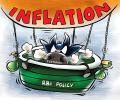
Amid a debate on the basis of a monetary policy stance, one may be curious enough to know how non-food retail inflation has behaved over the years in India. Let the eager souls catch a glimpse of facts. In the past 10 years, non-food inflation came down below 4 per cent on two occasions - pre-Covid period of 2019-20 and now in the first four months of the current financial year (FY25).

'India is not so distant from years of high and entrenched inflationary expectations that it should start trying to play games with the economy the way the West's central bankers think they are entitled to,' argues Mihir S Sharma.

'The finance ministry and public sector banks have tried to keep the names of wilful defaulters secret.' 'Secrecy and concealing information are inbred among banks and even the RBI,' observes Debashis Basu, editor, www.moneylife.in.

Moody's assumes that the RBI will continue to pursue price and financial stability and implement policies towards these goals.
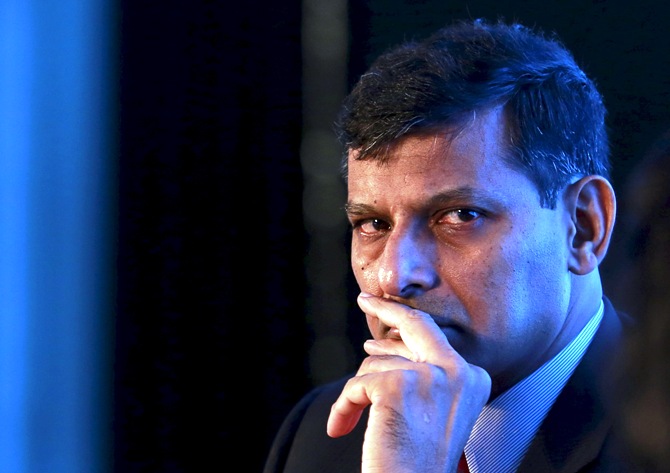
In the past, there have been instances of people getting fake e-mails in the name of RBI.

RBI, govt steps to help banks end NPA woes by Mar'17: Rajan

Raghuram Rajan's three-year term is the shortest of any G20 country and the recent governors have been given second terms as much as seven months in advance.

The RBI may grant licences for setting up small finance and payment banks by April 2015.

Justice BV Nagarathna said she had to dissent against the demonetisation move by the central government as in 2016, when the decision was announced, the Rs 500 and Rs 1,000 notes comprised 86 per cent of the total currency notes in circulation, and 98 per cent of it came back after they were banned.

The evolving RBI-government relationship, a reversal in the interest rate cycle and return to profitability will dominate bankers' conversation this year, says Tamal Bandyopadhyay.
The Reserve Bank is expected to go for another rate hike of 0.40 per cent at the scheduled review of the monetary policy next week, a foreign brokerage said on Friday. The central bank's rate setting panel will follow it up with a 0.35 per cent hike in rates at the next review in August, or make it into a 0.50 per cent hike next week and a 0.25 per cent increase in August, to make the total quantum of rate hikes at 0.75 per cent, the report by Bofa Securities said. On May 4, the Reserve Bank of India (RBI) hiked rates by 0.40 per cent, and Governor Shaktikanta Das has already called a rate hike at the forthcoming review as a "no brainer" given the pressure to maintain its core mandate of inflation in the targeted band of under 6 per cent.

It would be beneficial for the economy to hold on to high interest rates till inflation numbers are under control.
These changes will entail a relook at the various laws governing banks in the country - the two Bank Nationalisation Acts (passed in 1970 and 1980); the State Bank of India (SBI) Act of 1955; and the Companies Act of 2013.

Bankers expect RBI to help them spur lending growth.

The ruling Congress is seeking to retain power in Chhattisgarh by banking on the welfare schemes of the Bhupesh Baghel government, while the Bharatiya Janata Party is hoping to corner it on the issues of alleged corruption, religious conversions and unfulfilled poll promises.
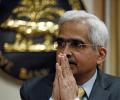
The Reserve Bank on Wednesday increased the benchmark lending rate by 40 basis points (bps) to 4.40 per cent in a bid to contain inflation, which has remained stubbornly above the target zone of 6 per cent for the last three months. The decision follows an unscheduled meeting of the Monetary Policy Committee (MPC), with all six members unanimously voting for a rate hike while maintaining the accommodative stance. While the inflation has remained above the targetted 6 per cent since January, RBI Governor Shaktikanta Das said the inflation print in April is also likely to be high.

India should not be left behind. It should join the seven central banks which are studying feasibility and safeguards necessary to eliminate risks, particularly from hacking, advises former foreign secretary Shyam Saran.
The discussion paper is released at a time when the central bank is sifting through 26 applications seeking an entry into the fray.
Will RBI chief have the final say, in the form of a veto

The regulatory actions, undertaken by the RBI and the government, came hours after finance ministry sources confirmed that SBI was directed to bail out the troubled lender. For the next month, Yes Bank will led by the RBI-appointed administrator Prashant Kumar, an ex-chief financial officer of SBI.

It will be the second Budget of the Modi 3.0 government and eighth straight Budget for Nirmala Sitharaman, rare in Indian polity.

Former RBI governor R Gandhi said that the RBI needs to re-introduce a one-time restructuring package and mere moratoriums will not suffice in unprecedented times like the COVID-19 pandemic.

The country has come a long way in the process of financial inclusion, Raghuram Rajan said, but "still has a way to go".

The monthly Rs 2500 payment for poor women is expected to cost Rs 11,000 crore while the pension scheme of Rs 2000 for every senior citizen will cost around Rs 4100 crore. The Yamuna clean up will cost over Rs 10,000 crore while a similar amount is required to upgrade Delhi's hospitals. Ultimately, the new BJP government will have no choice but to ask the centre for financial support, notes Rashme Sehgal.

Extending its support to Saarc Bank, Sri Lanka on Thursday said the proposed financial institution will help in alleviating poverty in the South Asian region.
